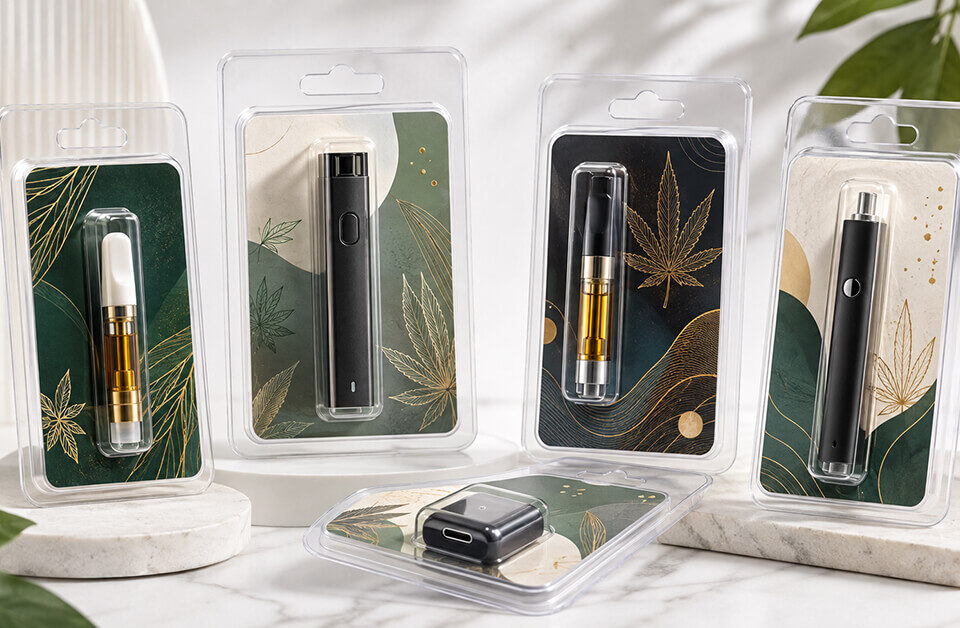

Sustainability has become an increasingly important consideration for cannabis brands, but packaging for vape products presents a unique challenge.
Brands need packaging that protects the product, supports regulatory requirements, communicates the brand effectively, and helps prevent children from gaining access to the contents.
At the same time, many businesses are looking for ways to reduce unnecessary plastic, use more recyclable materials, and lower the environmental impact of their packaging.
This raises an important question: can child-resistant vape packaging be both safe and environmentally responsible?
The answer is yes, provided that sustainability is considered during the packaging development process rather than added as an afterthought.
Material selection, structural engineering, package dimensions, printing methods, and finishing options can all influence the environmental impact of a package.
By making thoughtful decisions in these areas, cannabis brands can create packaging that supports child resistance without relying on excessive materials.
This guide explains how safety and sustainability can work together and what cannabis brands should consider when developing environmentally responsible vape cartridge packaging.
Why Child-Resistant Vape Packaging Is Important
The primary purpose of child-resistant vape packaging is to make it more difficult for children to gain access to products that are intended only for adults.
Cannabis vape cartridges and related products may contain regulated substances, making secure packaging especially important.
Child-resistant packaging is different from ordinary product packaging because the opening system is intentionally designed to require actions that are more difficult for young children to perform.
Depending on the package design, this may involve pressing, sliding, squeezing, pulling, or performing more than one action at the same time.
However, child resistance does not mean that the package should be impossible for adults to use.
A well-designed package should balance security with practical adult accessibility.
This is one reason structural design is so important when developing packaging for cannabis vape products.
Protecting Children From Accidental Access
Cannabis packaging should help reduce the possibility of unintended access by children while still protecting the vape cartridge itself.
A package that looks attractive but does not provide an appropriate child-resistant opening mechanism may fail to meet the practical safety needs of the product.
For this reason, child-resistant vape packaging should be treated as a functional packaging system rather than simply a printed box.
The closure mechanism, structural strength, materials, and overall construction must work together.
Brands should also avoid making changes to a child-resistant structure without understanding how those modifications could affect its performance.
Even small changes to dimensions, locking tabs, inserts, or material thickness may influence how the package opens and closes.
Supporting Cannabis Packaging Compliance
Cannabis packaging requirements vary between countries, states, provinces, and other jurisdictions.
Different markets may also apply different rules depending on the type of cannabis product being sold.
For that reason, brands should confirm the requirements that apply to their specific products before ordering packaging in large quantities.
A packaging supplier can help with structural development and material selection, but the brand should still verify applicable regulatory requirements for the markets where its products will be sold.
Where testing or certification is required, packaging should be developed with those requirements in mind from the beginning.
This reduces the risk of investing in packaging that later needs significant structural changes.
What Makes Vape Packaging Sustainable?
Sustainable packaging is not defined by a single material or feature.
A package may use recycled paper but still contain excessive components, oversized dimensions, difficult-to-recycle laminations, or unnecessary plastic inserts.
A more practical approach is to evaluate the entire packaging system.
This includes the amount of material used, where the materials come from, how efficiently the package is manufactured and transported, and what happens to it after the consumer has finished using it.
For child-resistant vape packaging, sustainability should therefore be considered alongside safety, durability, branding, and regulatory needs.
Using Recyclable Packaging Materials
Paperboard and cardboard are common materials for custom cannabis packaging because they can provide strong printing surfaces, structural versatility, and potential recyclability.
Where appropriate, brands can consider paper-based structures that reduce the need for plastic components.
Packaging can also be designed with fewer mixed materials, which may make disposal easier for consumers.
However, recyclability depends on more than the main substrate.
Laminations, metallic films, plastic windows, adhesives, coatings, inserts, and other finishing elements can affect whether a package is accepted by local recycling systems.
For this reason, brands should evaluate the entire construction rather than simply describing the outer box as recyclable.
Choosing Recycled and Responsibly Sourced Materials
Recycled paperboard may be suitable for many types of child-resistant vape cartridge packaging.
Using recycled content can reduce dependence on virgin fiber while still providing sufficient printing and structural performance for many box designs.
Responsibly sourced virgin paperboard can also be considered when recycled material does not provide the strength, appearance, or consistency needed for a particular packaging structure.
Brands may also ask packaging suppliers about paper sourced from responsibly managed forests or materials carrying recognized forestry certifications.
The appropriate option will depend on the packaging design, product requirements, budget, and intended brand positioning.
Reducing Packaging Material Without Sacrificing Protection
One of the simplest ways to improve packaging sustainability is to use less material.
Oversized packaging may use more paperboard, inserts, coatings, printing ink, storage space, and shipping volume than necessary.
By designing the package around the actual dimensions of the vape cartridge, brands can often reduce material use without reducing product protection.
The goal is not to make packaging as small or lightweight as possible.
The goal is to use enough material to provide protection and child resistance while eliminating components that do not serve a meaningful function.
Can Child-Resistant Vape Packaging Be Eco-Friendly?
Yes. Safety and sustainability do not have to be opposing objectives.
The key is to design child-resistant vape packaging so that the child-resistant function comes from efficient structural engineering rather than from excessive layers, oversized boxes, or unnecessary packaging components.
For example, a well-engineered paperboard package may use locking tabs, sleeves, trays, or coordinated opening actions to provide a child-resistant mechanism.
Depending on the design and requirements, these structures may reduce reliance on additional plastic components.
Sustainability can also be improved by considering how the package will be produced and shipped.
Right-sized boxes can reduce material consumption and may allow more units to fit into shipping cartons.
Simplified finishes can reduce unnecessary processing, while carefully selected materials may make disposal more straightforward.
The most sustainable package is therefore not always the one made from the most unusual material. In many cases, an efficient, well-designed package using conventional recyclable materials may provide a better balance of safety, durability, cost, and environmental responsibility.
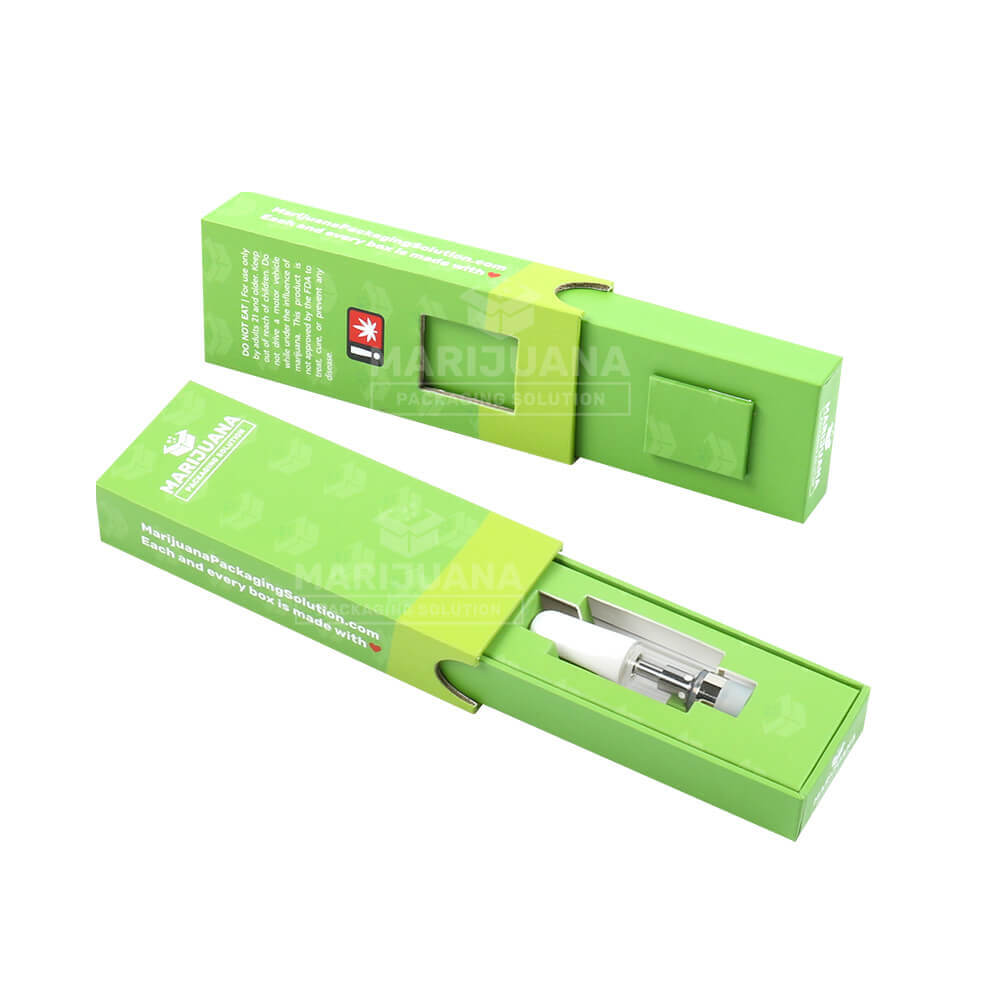
Sustainable Materials for Child-Resistant Vape Packaging
Material selection has a major influence on the performance and sustainability of cannabis packaging.
The best option depends on the child-resistant mechanism, product dimensions, desired appearance, distribution environment, and budget.
Paperboard and Cardboard
Paperboard is widely used for cannabis vape packaging because it offers a combination of strength, printability, and structural flexibility.
It can be cut, folded, scored, and assembled into a wide range of box formats.
This allows packaging engineers to develop child-resistant structures without relying exclusively on rigid plastic containers.
Paperboard also provides a suitable surface for custom branding, product information, warning statements, and decorative finishes.
When designing child-resistant vape packaging from paperboard, material thickness and structural strength should be selected carefully.
A package that is too thin may not maintain its locking function, while unnecessarily thick material can increase cost and material consumption.
Recycled Paperboard
Recycled paperboard can help brands reduce their use of virgin fiber.
It is often suitable for folding cartons, sleeves, and other secondary packaging applications.
However, recycled content can sometimes affect surface smoothness, print consistency, stiffness, and finishing performance.
Brands should therefore request material samples and production prototypes before committing to a large order.
A recycled substrate should be selected because it meets the package’s functional requirements as well as its sustainability goals.
Kraft Paper Packaging
Kraft paper has become popular among brands seeking a natural or environmentally conscious visual identity.
Its brown or unbleached appearance can communicate simplicity and reduced processing.
Kraft materials may be suitable for some child-resistant vape cartridge packaging boxes, particularly when combined with an effective child-resistant structure.
However, the appearance of kraft paper should not be confused with guaranteed sustainability.
The complete package still needs to be evaluated based on material sourcing, coatings, adhesives, printing, inserts, and end-of-life considerations.
Plastic Reduction and Hybrid Packaging
Some vape packaging structures may still require plastic components to achieve specific functional, protective, or regulatory objectives.
In these cases, sustainability does not necessarily require eliminating plastic completely.
A more realistic approach may be to reduce the amount of plastic used, simplify the number of materials, or design components so they can be separated more easily.
Brands should focus on measurable improvements rather than making sustainability claims that the packaging construction cannot support.
How Child-Resistant Vape Cartridge Packaging Can Be Designed More Sustainably
The structure of the package can be just as important as the material itself. Efficient packaging engineering can reduce waste while maintaining product protection and child resistance.
Use Efficient Child-Resistant Opening Mechanisms
Child-resistant packages may use push-and-slide, press-and-pull, locking-tab, or multi-action opening systems.
The specific mechanism should be selected according to the packaging format and applicable requirements.
An efficient mechanism can provide the necessary functionality without requiring excessive components.
When developing child-resistant vape cartridge packaging, brands should work with packaging engineers to determine whether the child-resistant feature can be built directly into the box structure.
This can sometimes reduce the need for separate plastic closures or additional outer packaging.
Reduce Oversized Packaging
Vape cartridges are relatively small products, yet some are placed inside boxes that are significantly larger than necessary.
Reducing unnecessary empty space can lower material consumption and potentially improve shipping efficiency. It can also create a cleaner, more intentional presentation.
Custom sizing is especially valuable for cartridges because dimensions can vary depending on cartridge capacity, mouthpiece shape, protective tubes, and other product components.
A well-fitted package should provide enough space for protection without creating unnecessary volume.
Design for Recycling
Brands should consider recyclability during the initial design process rather than after production.
Where possible, using fewer material types can make disposal simpler. Avoiding unnecessary plastic windows, metallic films, heavy laminations, and difficult-to-separate inserts may also improve the recyclability of paper-based packaging.
Clear disposal information can help consumers understand how different packaging components should be handled.
It is also important to avoid making broad environmental claims unless those claims can be supported by the actual packaging materials and the recycling infrastructure available in the intended market.
Custom Child-Resistant Vape Cartridge Packaging and Sustainability
Customization gives cannabis brands greater control over both packaging performance and environmental impact.
With custom child-resistant vape cartridge packaging, the package can be designed around the exact product dimensions rather than forcing a cartridge into a standard box that may be too large.
Custom structural engineering can also help reduce unnecessary inserts, optimize material thickness, and incorporate child-resistant opening features directly into the package design.
The result can be a more efficient packaging system that supports product protection, compliance objectives, branding, and sustainability at the same time.
Sustainable Printing and Finishing Options
Printing and finishing choices can significantly influence the appearance and environmental profile of a package.
Brands may consider water-based coatings, selected lower-impact ink systems, and restrained ink coverage where appropriate.
Eliminating unnecessary plastic lamination may also simplify the material construction of some packaging.
Embossing and debossing can provide visual and tactile interest without covering the entire package with decorative films. Spot finishes may also be used selectively rather than applying complex treatments across every surface.
Sustainable design does not have to look plain. Thoughtful typography, strong color choices, structural details, and premium paperboard can create attractive packaging without relying on excessive decoration.
Child-Resistant Vape Cartridge Packaging Boxes: Key Design Considerations
Sustainability should never come at the expense of the core functions of the package.
Child-resistant vape cartridge packaging boxes still need to protect the product, support child resistance, remain practical for adult users, and communicate the brand effectively.
Product Protection
Vape cartridges can be vulnerable to movement, scratching, impact, and crushing during transportation and retail handling.
The package should hold the cartridge securely and prevent unnecessary movement.
Depending on the product, a paperboard insert, molded fiber insert, or other fitted structure may be appropriate.
An insert should only be used when it serves a clear protective or functional purpose. Eliminating unnecessary inserts can help reduce material use.
Child Resistance
The opening mechanism is one of the most important elements of child-resistant vape packaging.
The structure should operate consistently across production units and should not become ineffective because of minor dimensional changes, weak materials, or poor assembly.
If a tested or certified structure is being used, brands should be cautious about modifying critical components without determining whether additional evaluation is required.
Adult Accessibility
Child-resistant packaging should still be usable by intended adult consumers.
Extremely complicated packaging can create frustration, damage the product experience, and make instructions difficult to follow.
Clear opening directions and intuitive structural design can help adults understand how the package works.
Accessibility considerations may be especially important for consumers who have reduced hand strength or dexterity.
Branding and Shelf Presentation
Sustainable cannabis packaging still needs to perform as a marketing tool.
Logo placement, typography, colors, finishes, and structural design can help distinguish a product at retail. Brands can choose a minimalist environmental aesthetic or create a more premium appearance while still limiting unnecessary materials.
The most effective packaging integrates branding into the structure rather than treating decoration as an additional layer.
Common Challenges When Making Child-Resistant Vape Packaging Sustainable
Creating environmentally responsible child-resistant packaging involves trade-offs.
Understanding these challenges early can help brands make more informed packaging decisions.
Combining Multiple Materials
Some packaging structures contain paperboard, plastic, foam, adhesives, films, or metallic finishes.
These combinations may provide attractive visual effects or additional protection, but they can also make recycling more difficult.
Where possible, brands should consider whether the same function can be achieved with fewer material types.
Maintaining Structural Strength
Reducing material does not automatically make packaging more sustainable if the resulting package becomes damaged easily.
Weak packaging can lead to crushed cartons, product damage, returns, replacements, and wasted inventory.
These outcomes may create additional environmental impacts.
Material reduction should therefore be approached carefully.
Structural testing and prototyping can help determine the minimum practical material thickness.
Balancing Cost and Sustainability
Some recycled, certified, specialized, or lower-impact materials may cost more than conventional alternatives.
However, material price should not be evaluated in isolation.
Right-sizing a package, simplifying inserts, reducing decorative finishes, or improving shipping efficiency may offset some costs.
Brands should examine the complete packaging system rather than comparing only the price of individual materials.
Meeting Both Safety and Environmental Goals
The biggest challenge is often balancing multiple priorities.
A brand may want highly recyclable packaging, premium visual effects, strong product protection, child resistance, low cost, and fast production at the same time.
Not every packaging feature will be equally important. Safety and regulatory requirements should generally be treated as essential, while sustainability improvements can then be incorporated wherever they do not compromise those requirements.
How Cannabis Brands Can Choose Sustainable Child-Resistant Vape Packaging
Choosing appropriate child-resistant vape packaging starts with understanding the product and the market where it will be sold.
First, confirm the child-resistant packaging requirements that apply to the product.
Do not assume that a packaging format accepted in one jurisdiction will automatically meet requirements elsewhere.
Next, provide accurate product dimensions to the packaging manufacturer.
The exact size of the cartridge, mouthpiece, protective cap, and any accompanying accessories should be considered.
Brands can then evaluate available materials, including recyclable paperboard, recycled content, responsibly sourced fiber, or reduced-plastic constructions.
The child-resistant mechanism should be reviewed alongside the material choice. Some structures may require specific material thicknesses or tolerances to function correctly.
Printing and finishing options should also be considered carefully. Decorative features should support the brand without adding unnecessary materials or making the package significantly more difficult to recycle.
Before mass production, request samples or prototypes. This allows the brand to evaluate appearance, product fit, opening functionality, durability, and overall user experience.
Finally, review how the finished packaging will be packed into shipping cartons. Packaging dimensions that reduce unused shipping space may provide additional operational and environmental benefits.
Questions to Ask a Child-Resistant Vape Packaging Manufacturer
A packaging supplier can play an important role in helping cannabis brands balance safety, appearance, cost, and sustainability.
Before choosing a supplier, ask what child-resistant structures are available and whether documentation related to testing or certification can be provided where applicable.
You should also ask about recyclable and recycled materials, paper sourcing options, reduced-plastic structures, and available material thicknesses.
If you require custom child-resistant vape cartridge packaging, confirm whether the supplier can modify dimensions, inserts, and structural components around your exact product.
Other useful questions include whether prototypes are available, what printing and coating options are offered, what minimum order quantities apply, and how structural changes might affect child-resistant performance.
A knowledgeable packaging supplier should be able to explain not only what materials are available but also how those materials affect functionality, appearance, production, and cost.
Conclusion: Safety and Sustainability Can Work Together
Safety and sustainability are not mutually exclusive.
Well-designed child-resistant vape packaging can help restrict child access while reducing unnecessary materials and supporting more environmentally responsible packaging choices. Achieving this balance requires careful attention to structure, material selection, package dimensions, printing, finishing, and end-of-life considerations.
For cannabis brands, the most effective approach is to begin with safety and regulatory requirements and then identify practical opportunities to improve sustainability without compromising functionality.
Paperboard structures, recycled materials, reduced-plastic designs, efficient sizing, and simplified finishes can all contribute to a more sustainable packaging system when used appropriately.
Ultimately, the goal should not simply be to create packaging that looks environmentally friendly. It should be to develop child-resistant vape packaging that uses materials efficiently, protects the product, supports applicable requirements, and provides a professional experience for adult consumers.
By working with an experienced packaging manufacturer and testing structural concepts before mass production, cannabis brands can develop packaging that brings safety, branding, and environmental responsibility together in one practical solution.
A useful next step would be to add an SEO meta title, meta description, URL slug, and internal-link suggestions so the article is ready for publication and on-page optimization.