In the rapidly expanding cannabis edibles market, your product’s packaging serves as the frontline ambassador for your brand.
It is the first physical touchpoint a consumer has with your product, carrying the dual responsibility of ensuring product safety and broadcasting brand identity.
Unfortunately, a common misstep brands make is treating packaging as an afterthought, leading to improperly sized containers that result in crushed goods, wasted shipping space, and a subpar consumer experience. The solution lies in precision engineering.
By investing in precisely engineered custom retail boxes, you protect your delicate products, seamlessly integrate mandatory compliance information, and elevate the unboxing experience from ordinary to premium.
When you utilize the right custom retail packaging boxes, you set the foundation for brand loyalty and dispensary success.
The Fundamentals of Sizing Your Packaging
The Anatomy of Measurement
Precision in packaging begins with mastering the anatomy of measurement: Length, Width, and Depth (L x W x D).
As a packaging specialist, I always advise clients to measure the primary packaging—such as the mylar bag, blister pack, or glass jar that holds the edible—rather than just the edible itself.
The internal dimensions of your paper box must provide enough clearance to allow the primary container to slide in smoothly without catching on the paperboard flaps, yet remain tight enough to prevent rattling.
Eliminating Dead Space
Eliminating dead space is not merely an aesthetic choice; it is a financial imperative.
The structural and financial benefits of a snug fit are immense.
Precision sizing in your custom retail boxes reduces the amount of raw material required, which instantly lowers your unit cost.
Furthermore, shipping logistics heavily favor optimized dimensions.
By reducing the dimensional weight of your shipments, you save significantly on freight costs while ensuring the product does not shift and sustain damage during transit.
Accommodating Inserts
When dealing with delicate items like artisanal chocolates or glass tincture dropper bottles for liquid edibles, standard sizing is often not enough.
You must calculate the necessary interior dimensions to accommodate custom paperboard inserts or dividers.
These inserts hold fragile items securely in place, absorbing shock and preventing product-to-product contact.
Utilizing precisely measured custom boxes for retail packaging with tailored inserts ensures your product arrives in the exact pristine condition it left the facility.
Selecting the Optimal Structural Design for Edibles
Popular Box Styles
Choosing the right structural style is critical for both functionality and budget.
For everyday items like gummies or hard lozenges, Straight Tuck End (STE) and Reverse Tuck End (RTE) boxes are the industry standard.
They are cost-effective, easy to assemble by hand or machine, and offer excellent structural integrity.
For a more premium offering, such as high-end baked goods, a Sleeve and Tray (also known as a drawer box) provides a luxurious, slide-to-reveal unboxing experience that justifies a higher price point.
Maximizing Point-of-Sale Impact
Transitioning a standard box into a marketing tool requires strategic structural design.
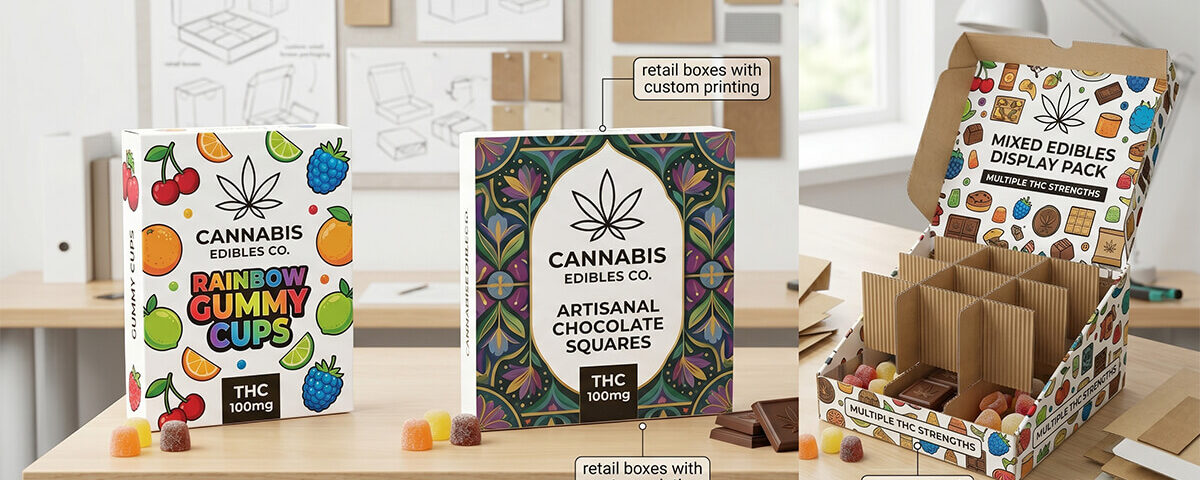
You can capture significant attention on dispensary shelves by utilizing custom retail display boxes.
These often take the form of tear-away display packers, where the top or front panel is perforated and removed by the budtender, instantly transforming a shipping vessel into a structurally sound, branded countertop display for individual units.
Child-Resistant (CR) Integration
In the cannabis industry, compliance is non-negotiable.
While paperboard is inherently pliable, modern structural engineering allows us to integrate clever folding techniques and locking tabs to create certified CR packaging.
Whether modifying a standard structure or pairing retail boxes custom tailored to fit secondary plastic CR mechanisms,
your structure must pass strict state regulations without becoming a frustrating puzzle for the end adult consumer.
Material Selection: Merging Structure with Safety
Food-Safe and Odor-Resistant Barriers
The material you choose is the literal foundation of any custom retail boxes.
For edibles, selecting the right paperboard weight—typically between 16pt and 24pt Solid Bleached Sulfate (SBS) or natural kraft board—is essential for maintaining structural rigidity.
However, the inside matters just as much. Depending on the primary packaging,
you may need to apply food-safe coatings or laminations to the paperboard to act as an odor barrier and protect the box’s exterior from oils or moisture, preserving the product’s shelf life and the packaging’s aesthetic.
Sustainability
Today’s consumers are highly environmentally conscious, making sustainable structuring a top priority.
You can design eco-friendly custom retail boxes packaging that does not compromise on durability.
By utilizing rigid, recycled kraft paperboard, soy-based inks,
and structural designs that require zero toxic glues (such as crash-bottom or auto-lock boxes), brands can appeal to green consumers while maintaining a premium, robust feel.
Structuring for Specific Cannabis Edible Categories
Gummies and Hard Candies
Lightweight and compact products like gummies require structures that prioritize security and portability.
Designing custom retail product boxes for these items usually involves compact RTE structures that fit easily into a pocket or purse.
The focus here is on tight tolerances to keep the inner foil or blister pack from shifting, ensuring the candies remain intact and the packaging remains discreet yet functional.
Chocolates and Baked Goods
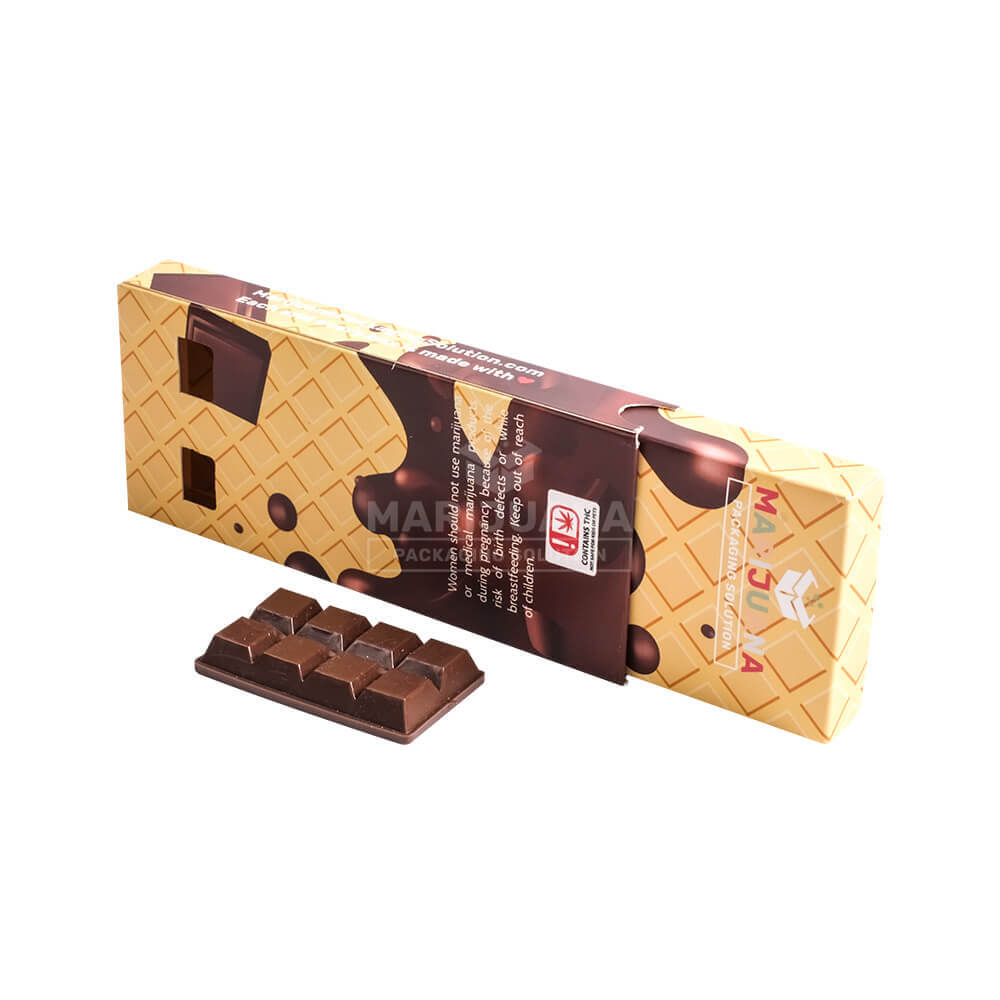
Conversely, designing custom retail boxes for chocolates and baked goods requires a completely different approach.
These products are highly susceptible to temperature fluctuations and melting.
The structural design must account for thicker, grease-resistant barriers or specialized wax linings.
Additionally, the box must be rigid enough to prevent crushing, often utilizing double-wall fold structures or rigid board materials to ensure that a beautifully crafted chocolate bar doesn’t snap before the consumer opens it.
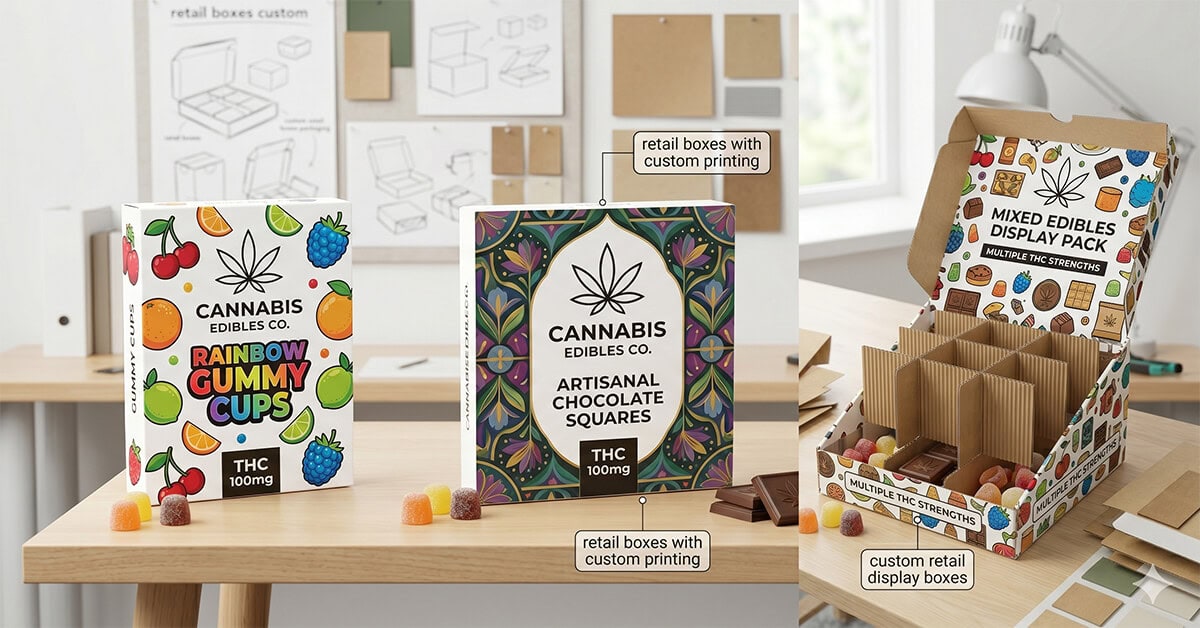
Image generated with Google Gemini
Integrating Artwork and Compliance into Your Structure
Brand Placement
A well-engineered box is the perfect canvas for your brand identity.
Understanding the structural folds and display orientation is crucial for the layout of your custom printed retail boxes.
You must design custom retail boxes with logo positioning that ensures your primary branding is front and center when sitting on a shelf,
and that secondary elements like mission statements or flavor profiles are logically placed on the side or back panels.
The artwork must harmonize with the box’s physical structure, ensuring no vital text is lost in the folds or glue tabs.
The Real Estate of Compliance
Perhaps the greatest challenge in cannabis packaging is balancing aesthetic design with heavy regulatory requirements.
Your structure must provide ample, legible surface area—the “real estate” of the box.
High-quality retail boxes with custom printing must clearly display mandatory state warning labels, universal THC symbols, batch barcodes, and nutritional fact panels.
A skilled structural designer will size the panels precisely to ensure these elements fit legally and cleanly without cluttering or overpowering the brand’s visual identity.
Exact sizing and intelligent structural design are not mere details; they are absolute necessities in the competitive edibles market.
From protecting fragile chocolates to ensuring legal compliance and reducing shipping costs, the physical engineering of your packaging dictates how the market perceives your brand.
Investing in premium custom retail boxes is an investment in your product’s integrity and your brand’s longevity. Do not leave your packaging to chance.
Partner with a professional packaging specialist today to engineer the perfect custom retail boxes tailored specifically to the unique needs of your edible products, and watch your brand presence elevate.